App pricing
What the app charges, versus the website.
- App price per SKU
- Web price for the same SKU
- App-web delta computed
- App-exclusive price flags
- Price change detection in-app

Scalable web, app and AI-powered collection across 40+ countries.
All services → By industry
Repricing driven by competitor moves rather than a weekly review.
Explore → Pricing & Promotions
 Brand & Intelligence
 Digital Shelf & Search
 Assortment
 For Retailers
Which solution fits?
Talk to ExpertTalabat, Careem Quik and Noon Minutes across 18 GCC cities.
Launch Demo →Tesco, Sainsbury's, Asda, Morrisons and Aldi, daily.
Get Early Access → By Industry
 E-Commerce Dashboard
 Flipkart Insights (Live) #1
 Grocery Intelligence
.svg) Grocery Price (U.S.)
Grocery Price (U.S.)
.svg) Quick Commerce (India) HOT
Quick Commerce (India) HOT
 Food & Restaurant
 Fashion Intelligence
 Automotive
 Travel & Hospitality
 Real Estate
 Food Delivery Intelligence NEW
 OTT & Streaming NEW
 Fuel & EV Charging Price Tracker NEW
 By Use Case
 Pricing Intelligence
 Digital Shelf Analytics
 MAP Monitoring HOT
 Cross-Border Price Parity NEW
 Share of Search
 Review Sentiment
 Kitchen Market Gaps NEW
 Dynamic Pricing / AI Repricing NEW
 Promotions & Deals Alerts NEW
 B2B / POI & Lead Data NEW
 AI Search Visibility Dashboard NEW
 Baby Products on Quick Commerce NEW
 Hotel & Flight Rate Parity NEW
 By Region
 Flipkart Real-Time Insights
 Quick Commerce — Zepto · Blinkit
 Pincode Price Tracker
 GCC Q-Commerce — Talabat · Noon NEW
 UK Grocery — Tesco, Sainsbury's, Asda
 AU Grocery — Coles & Woolworths NEW
Sources we already run pipelines against. Download a real sample from any of them.
Browse coverage → Marketplace Scrapers
 Developer APIs
 Universal APIs
 Delivery & SDKs
Fixed monthly retainer, named engineer, no per-request metering.
Managed Data API → Knowledge Center
 Guides & Playbooks
 Downloads & Tools
 Trust & Company
Scalable web, app and AI-powered collection across 40+ countries.
All 58 services → By industryRepricing driven by competitor moves rather than a weekly review.
Explore → Pricing & Promotions
Brand & Intelligence
Digital Shelf & Search
Assortment For RetailersWhich solution fits?
Talk to ExpertSources we already run pipelines against. Download a real sample from any of them.
Browse coverage →Talabat, Careem Quik and Noon Minutes across 18 GCC cities.
Launch Demo →Tesco, Sainsbury's, Asda, Morrisons and Aldi, daily.
Get Early Access → By Industry
E-Commerce Dashboard
Flipkart Insights (Live) #1
Grocery Intelligence
Grocery Price (U.S.)
Quick Commerce (India) HOT
Food & Restaurant
Fashion Intelligence
Automotive
Travel & Hospitality
Real Estate
Food Delivery Intelligence NEW
OTT & Streaming NEW
Fuel & EV Charging Price Tracker NEW
By Use Case
Pricing Intelligence
Digital Shelf Analytics
MAP Monitoring HOT
Cross-Border Price Parity NEW
Share of Search
Review Sentiment
Kitchen Market Gaps NEW
Dynamic Pricing / AI Repricing NEW
Promotions & Deals Alerts NEW
B2B / POI & Lead Data NEW
AI Search Visibility Dashboard NEW
Baby Products on Quick Commerce NEW
Hotel & Flight Rate Parity NEW
By Region Flipkart Real-Time Insights
Quick Commerce — Zepto · Blinkit
Pincode Price Tracker
GCC Q-Commerce — Talabat · Noon NEW
UK Grocery — Tesco, Sainsbury's, Asda
AU Grocery — Coles & Woolworths NEW
Marketplace Scrapers
Developer APIs Universal APIs Delivery & SDKsFixed monthly retainer, named engineer, no per-request metering.
Managed Data API → Knowledge Center
Guides & Playbooks
Downloads & Tools
Trust & CompanyApp-only pricing and offers that never appear on the website.
A growing share of retail promotion is app-exclusive by design. If your competitive data comes only from websites, you are missing the offers that were built specifically to be invisible there.
Free pilot on your own sources, returned in 24 hours. No card, no trial clock — and you keep the sample data either way.
Last verified 5 August 2026 by the Actowiz Solutions Data Engineering team.
Mobile app scraping collects content shown inside an app: prices, offers, catalogues and availability as an anonymous user of that app would see them. It matters because a growing share of retail promotion is deliberately app-exclusive.
Two different services are often conflated:
If you want to know how a competitor's app ranks, that is app store data. If you want to know what a competitor's app is charging, that is this page.
In our runs, around 18% of SKUs at app-enabled retailers show a price or offer difference between app and web. A dataset built only on websites systematically understates competitor promotional intensity.
We collect only what an anonymous user of a freshly installed app can see. We do not create accounts, do not use client or third-party credentials, do not collect logged-in or personalised content, and do not place orders. Every record carries auth_state, which is always anonymous. Where an offer is visible only after login, we record that it exists and is gated rather than obtaining its content.
Pricing and offer deltas against the website are the largest use case by a wide margin.
What the app charges, versus the website.
Promotions built to be invisible on the web.
What is actually purchasable in-app.
Because app content is often location-bound.
How products are presented in-app.
Because app content changes by release.
A managed engagement, not a tool licence. We own the pipeline and everything that breaks in it.
Every record carries platform, app version and auth state, because all three change what content is shown.
| Field | Type | What it captures | Refresh |
|---|---|---|---|
app / platform |
string / enum | Which app and whether Android or iOS, since content frequently differs | Every record |
app_version |
string | App version observed, because in-app content changes by release | Every record |
country / zone |
string | Country and delivery zone or store context where app content varies by location | Every record |
sku / product_ref |
string | Product identity, joinable to your web-sourced records | Every record |
app_price / web_price / app_web_delta |
decimal | App price, the website price for the same SKU, and the computed gap | Per cadence |
app_exclusive_offer / offer_mechanic |
boolean / enum | Whether the offer is app-only and its normalised mechanic | Per cadence |
web_equivalent_found |
boolean | Whether a matching offer exists on the website, which defines exclusivity | Per cadence |
in_stock / delivery_promise |
boolean / int | Availability and delivery promise as displayed inside the app | Per cadence |
surface |
enum | Which app surface the record came from: product detail, offers tab, search, category | Every record |
auth_state |
constant | Always anonymous, stated explicitly so the boundary is auditable | Every record |
gated_offer_present |
boolean | Where an offer exists but requires login, recorded without obtaining its content | Per cadence |
auth_state is a constant reading anonymous. It is redundant data by design, so anyone auditing the dataset can see that no logged-in or personalised content was collected.
App-web divergence is concentrated in retail, grocery, delivery and travel. Elsewhere the website usually shows the same data.
Where an app shows the same content as the website, we will tell you rather than charging for a parallel collection that adds nothing. App collection is worth it specifically where divergence exists. Request a source we don't list →
We deliver into 40+ countries. These are the markets where this particular service is requested most, and the reason demand concentrates there.
| Market | Why demand concentrates here |
|---|---|
| India | The most aggressive app-exclusive pricing in the world across quick commerce and food delivery, where web-only monitoring misses most promotional activity. |
| United Kingdom & European Union | Grocery and retail apps with app-only offers tied to loyalty programmes, presented differently from web. |
| United Arab Emirates & Saudi Arabia | App-first delivery and quick commerce markets where zone-level app catalogues differ materially from websites. |
| United States | Large retail apps with app-exclusive promotions and app-only pricing on selected categories. |
We run production collection across 40+ countries. Coverage depth varies by market and by source, so we confirm what is actually available for your specific markets during scoping rather than claiming uniform global coverage. Ask about a market we don't list →
Pricing and promotions teams dominate, because app exclusivity is a pricing tactic.
Competitor app-only prices are invisible in web-sourced data, so promotional intensity is systematically understated.
App price per SKU with the web price and computed delta, so app-exclusive undercutting becomes visible.
Price competitiveness
App-exclusive offers are designed to be invisible to competitors watching the website.
App-only offer capture with mechanic classification, validity windows and whether a web equivalent exists.
Promotional response time
Retail partners may discount your products in-app in ways your web monitoring never sees.
Per-retailer app pricing on your SKUs with app-web deltas, so channel pricing conversations include app activity.
Price realisation
Dark store catalogues and pricing are app-first, and website data may not reflect zone reality.
Zone-level in-app catalogue, pricing and availability, matched to your SKU set.
On-shelf availability %
A competitor's app is a channel you cannot observe with web tooling.
In-app merchandising, shelf position, banners and search results as an anonymous user sees them.
Response time
App-only rates and member pricing shown publicly in-app can undercut your distribution assumptions.
Publicly visible in-app rate capture alongside web rates for the same stay parameters.
Rate parity integrity
Four patterns, with the outcome each is judged on.
The same SKU is collected in-app and on the website within the same window, with the delta computed, exposing app-exclusive discounting that web-only monitoring cannot see.
Outcome: Competitive price position corrected for a channel that was previously invisible.
Offers surfaces are collected and each offer checked for a website equivalent, so genuinely app-only promotions are identified with their validity windows.
Outcome: Promotional intensity measured including the channel built to hide it.
In-app catalogues are collected per delivery zone where content varies, matched to your SKU set, with availability as displayed in-app.
Outcome: Zone reality captured where the website does not expose it the same way.
Brand SKUs are tracked across retail partner apps with app-web deltas, giving evidence for channel conversations that web data alone cannot support.
Outcome: Partner discussions grounded in app-channel evidence with dates.
Clients rarely permit naming. These are real engagement shapes with identifying detail removed, so you can judge whether the work resembles your situation.
Competitive pricing came entirely from websites, while competitors ran app-exclusive offers designed specifically not to appear there.
In-app collection on a matched SKU set with app and web prices captured in the same window and the delta computed, plus offers-surface capture.
App-exclusive discounting became visible, and measured promotional intensity rose materially against the web-only baseline.
Quick commerce availability was tracked from web sources, which did not reflect what shoppers saw in-app by delivery zone.
Per-zone in-app catalogue, pricing and availability collection with app version and platform recorded on every record.
Zone reality was captured where the website did not expose it the same way, correcting availability reporting.
Examples are anonymised at client request. Named references are available on request under NDA. See published case studies →
Before you commit to anything, we run this service against your own sources and send you the output. If the coverage isn't there, the sample will show you that too — which is the point. We would rather lose the deal at the pilot than at month three.
Same collection pipeline and QA underneath. The difference is who holds the schedule and how the data reaches you.
We own the collection, the QA and the delivery. You receive clean data on a schedule and never touch a scraper.
Best fit: Teams who need the data, not the infrastructure.
The same collection pipeline exposed as an authenticated REST endpoint your systems query directly.
Best fit: Product and engineering teams building on live data.
A defined pull for a specific question — market sizing, diligence, a pitch, a one-off audit.
Best fit: Research, strategy and diligence work with a deadline.
Every engagement is quoted individually, because the honest answer depends on your scope: how many sources, how many records, how often, and how the data reaches you. We scope it with you, run a free pilot on your own sources, and then quote a fixed monthly figure — no per-request metering and no overage billing when volumes move. Request a quote and you will have a number after one call.
Only where the app genuinely shows different data. We will tell you if it does not.
| Consideration | In-house scraping team | Generic proxy / DIY tool | Actowiz managed feed |
|---|---|---|---|
| Time to first usable data | 6–12 weeks of engineering before anything is trustworthy | Days, but output needs manual cleanup before use | Free pilot in 24 hours, production in 5–10 business days |
| Who fixes it when a source changes | Your engineers, at the cost of their roadmap | You do — tools report failures, they don't resolve them | We do, same business day, inside the retainer |
| Data quality assurance | Whatever your team has time to build | None beyond HTTP success | Schema validation plus sampled human QA on every run |
| Compliance documentation | Rarely produced, then requested urgently by legal | Not provided; terms risk sits with you | Sources, method and lawful basis documented for review |
| Accountability | Distributed across a team with other priorities | A support ticket queue | A named engineer and an account owner |
| True annual cost | Engineer salaries, proxies, hosting, ongoing maintenance | Low licence fee plus significant hidden analyst time | One fixed monthly retainer, quoted after scoping |
App collection is the area where clients most often ask us to go further than we will, so it is worth being explicit about the line and the reasoning.
Content visible to an anonymous user of a freshly installed app: public catalogue, public pricing, public offers surfaces, availability and merchandising. Every record carries auth_state: anonymous.
We record that a gated offer exists via gated_offer_present without obtaining its content. Knowing a competitor runs member-only offers on a category is itself useful, and it is obtainable without crossing the line.
This costs us work. Clients do ask for logged-in app pricing, and some vendors supply it. Our position is that a vendor willing to operate inside authenticated sessions for you will do the same regarding you, and that the exposure attaches to the party using the data commercially — which is the client.
Two metadata fields that look like housekeeping and are actually load-bearing in this category: app_version and platform.
Android and iOS versions of the same retail app frequently differ — different rollout timing, sometimes different offer surfaces, occasionally different pricing presentation. Treating them as one source produces contradictions that look like collection errors.
We collect both where content diverges and record which produced each observation. Where the two are identical we collect one and say so, because charging for a parallel collection that adds nothing is not a service. The same principle governs whether app collection is worth adding at all: if a retailer's app shows the same data as its website, we will tell you and recommend web-only. Our quick commerce and food delivery services are where app-web divergence is most consistently material.
We first assess whether each app genuinely shows different content from its website, and tell you where app collection would add nothing.
You send us target sites, regions, SKUs or keywords. We return a field-level schema proposal, coverage estimate and refresh recommendation — usually within two working days.
We extract a real sample from your actual targets so you can inspect field fill rates, edge cases and match quality before any commitment.
Our engineers build extractors, then wire validation rules: type checks, range checks, duplicate detection and golden-record comparison against a manually verified subset.
Feeds run at your chosen cadence and land in the warehouse or bucket you already use. Schema changes are versioned and announced before they ship.
We watch coverage drift, fill rates and source changes daily. A named engineer owns your account, and layout breaks are fixed by us — not queued for you.
JSON, JSONL, CSV, Parquet or XLSX, delivered to Amazon S3, Google Cloud Storage, Azure Blob, SFTP, Snowflake, BigQuery, Databricks or a REST/GraphQL endpoint. Webhooks fire on completion, and every batch ships with a manifest containing row counts, schema version and QA results so your pipeline can fail loudly instead of silently ingesting a bad file.
We collect only content visible to an anonymous user of a publicly available app. We do not create accounts, use client or third-party credentials, collect logged-in or personalised content, place orders, or defeat app integrity protections. Every record carries auth_state as anonymous, and gated offers are recorded as present without obtaining their content.
These are contractual, not marketing copy. They appear in the engagement document.
| Commitment | What we hold ourselves to |
|---|---|
| Pilot turnaround | A real sample from your own sources within 24 hours of scoping, at no cost. |
| Go-live | Production collection running within 5–10 business days of sign-off. |
| Delivery punctuality | 99.5% on-schedule delivery, measured monthly and reported to you. |
| Breakage response | Source layout changes triaged same business day; critical sources inside 4 hours. |
| Data quality | Schema validation on every run plus sampled human QA before any delivery leaves us. |
| Escalation | A named engineer and an account owner, not a shared ticket queue. |
| Change requests | Field additions and source changes handled inside the retainer, not re-quoted. |
| Exit | Your historical data exported in full on request. No lock-in, no export fee. |
Plain definitions of the terms used on this page, so procurement and legal reviewers are working from the same vocabulary as your data team.
What pricing, promotions and compliance teams ask during evaluation.
Different layer entirely. App store data covers the listing about an app: rankings, ratings, in-app purchase tiers, release notes, ASO metadata. This service covers content inside an app: a retailer's app-only price on a specific SKU.
If you want to know how a competitor's app ranks, that is app store data. If you want to know what their app is charging, that is this service.
No. We collect only what an anonymous user of a freshly installed app can see. We do not create accounts, do not use client or third-party credentials, and do not collect logged-in or personalised content.
Every record carries auth_state reading anonymous, which is deliberately redundant so the boundary is auditable. Where an offer requires login we record gated_offer_present without obtaining its content — knowing a competitor runs member-only offers in a category is useful and obtainable without crossing the line.
In our runs, around 18% of SKUs at app-enabled retailers show a price or offer difference between app and website. It is concentrated in grocery, quick commerce, food delivery and general retail.
It varies enormously by retailer though. We assess divergence per app during scoping and will tell you where an app shows the same data as its website, because charging for a parallel collection that adds nothing is not a service.
Because in-app content changes by release, versions roll out gradually, and apps A/B test aggressively. Without version, two observations days apart from different versions look like a data inconsistency rather than a change.
Platform matters for the same reason: Android and iOS versions of the same retail app frequently differ in rollout timing and occasionally in offer surfaces. Treating them as one source produces contradictions that look like collection errors.
Yes, from public offers surfaces, with the mechanic classified, validity window captured and a check for whether a website equivalent exists — which is what defines exclusivity.
This is the highest-value output for most clients, because app exclusivity is a deliberate tactic to be invisible to competitors watching the web. A web-only dataset systematically understates competitor promotional intensity.
App terms generally restrict automated access, and we say so rather than implying otherwise. Our practice is anonymous, publicly visible surfaces only, at low request rates, without accounts, credentials, orders or defeating integrity protections.
You receive a written methodology document per app and a DPA before signature so your counsel can assess your specific use case. Vendors offering logged-in app data are operating inside authenticated sessions, and that exposure attaches to whoever uses the data commercially.
Yes, where app content varies by location, which is normal in grocery, quick commerce and delivery. Collection runs per zone using generic location input rather than customer accounts.
As with our quick commerce service, zone count is the main cost multiplier, so we scope the zone set deliberately rather than defaulting to full coverage.
Those where the app genuinely shows different content: grocery, quick commerce, food delivery, general retail and some travel. Elsewhere the website usually shows the same data and app collection adds cost without insight.
We assess per app during scoping and recommend web-only where that is the honest answer. It costs us revenue on those apps and it keeps the rest of the engagement credible.
We quote individually. App collection costs more per record than web collection because the surfaces are less accessible and version and platform variation add work. Zone coverage multiplies it further.
A focused SKU set across two or three apps in one market sits at the lighter end. Multi-app, multi-zone, both platforms sits considerably higher. One scoping call, a free pilot on your own SKUs within 24 hours including an app-web divergence report, then a fixed monthly quote. Request a quote.
Send us a SKU list and the apps you care about. We return in-app pricing with app-web deltas and an exclusivity report within 24 hours.
Free pilot, no card, no obligation. If an app shows the same data as the website, we'll tell you and recommend web-only.Our web scraping expertise is relied on by 4,000+ global enterprises including Zomato, Tata Consumer, Subway, and Expedia — helping them turn web data into growth.
Watch how businesses like yours are using Actowiz data to drive growth.
 4.8/5 Average Rating
 50+ Video Testimonials
 92% Client Retention
 50+ Countries Served
From Zomato to Expedia — see why global leaders trust us with their data.
Backed by automation, data volume, and enterprise-grade scale — we help businesses from startups to Fortune 500s extract competitive insights across the USA, UK, UAE, and beyond.


 Product Matching
 Attribute Tagging
 Content Optimization
 Sentiment Analysis
 Prompt-Based Reporting
We partner with agencies, system integrators, and technology platforms to deliver end-to-end solutions across the retail and digital shelf ecosystem.


.webp)
Use this web data RFP checklist to define scope, sources, fields, SLA, QA and pricing models, then score vendors fairly.
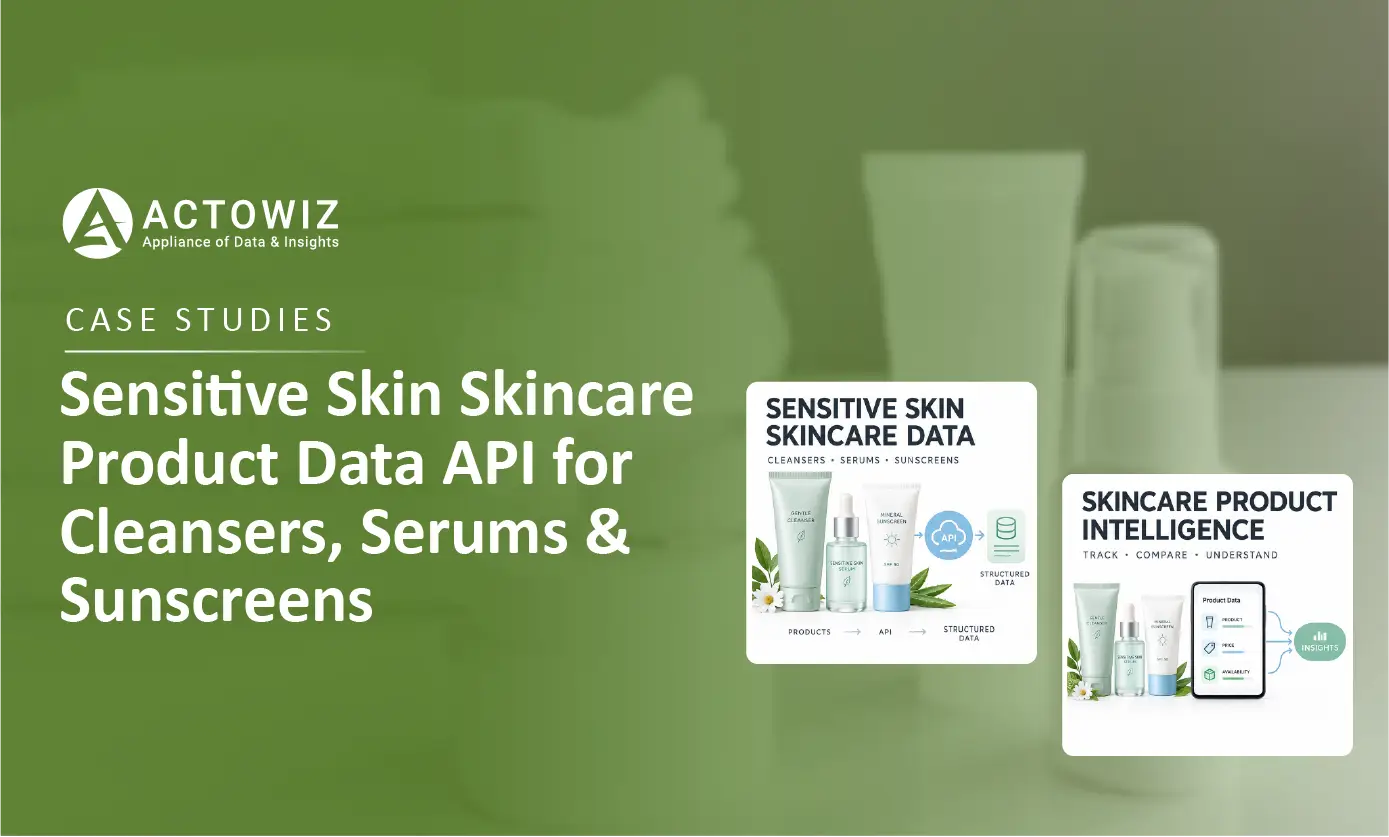
Sensitive Skin Skincare Product Data API helps brands track cleansers, serums, moisturizers, and sunscreens with structured product data.
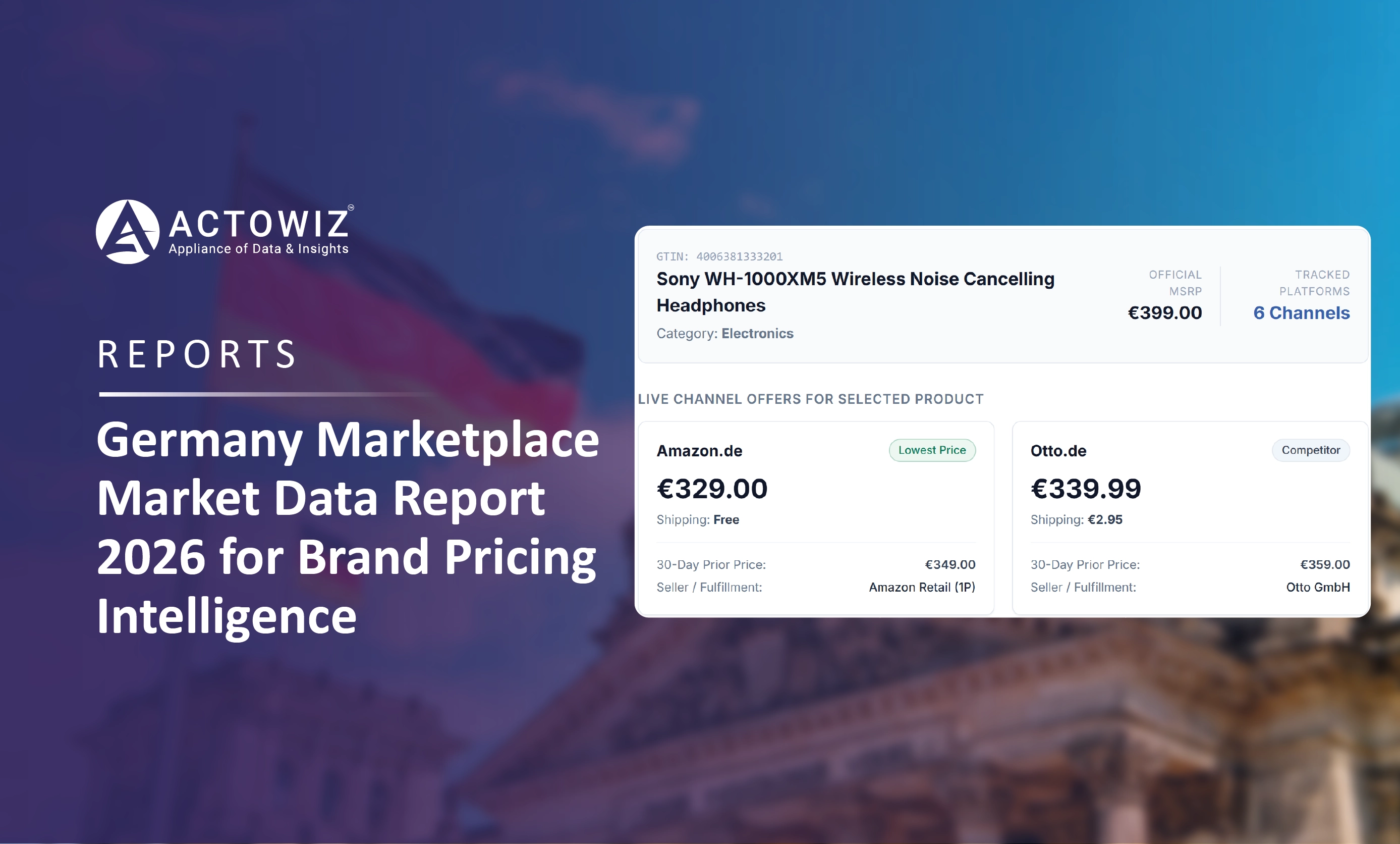
German marketplace data report 2026: online retail size, Amazon.de, Otto, Kaufland and Zalando price signals, PAngV rules and peak seasons.
Whether you're a startup or a Fortune 500 — we have the right plan for your data needs.